
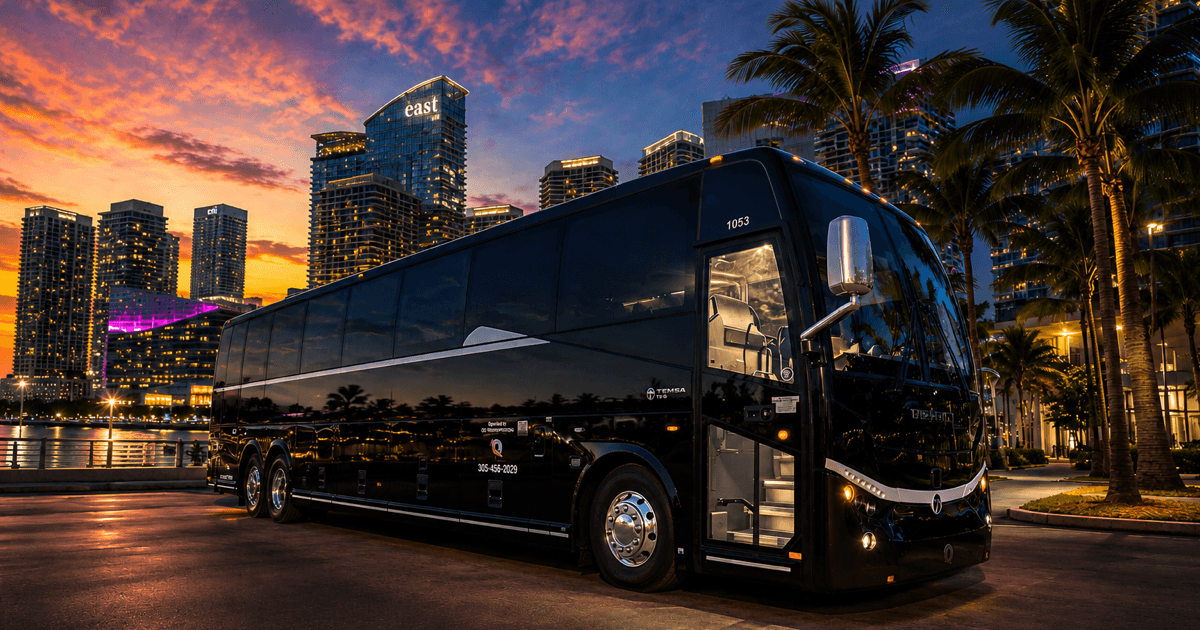
25 Vehicles. Limited Photography. One Completely Custom Website.
How Growth Choice built a completely custom digital presence for Miami Bus Company — combining original fleet photography, AI-assisted visual production, search-led architecture, and technical SEO / AEO from the ground up.

Alex Dovzhenko, Founder of Growth Choice
Client: miamibuscompany.com · Miami, FL · Group Transportation & Charter
Miami Bus Company
Client Overview
Fleet Breakdown
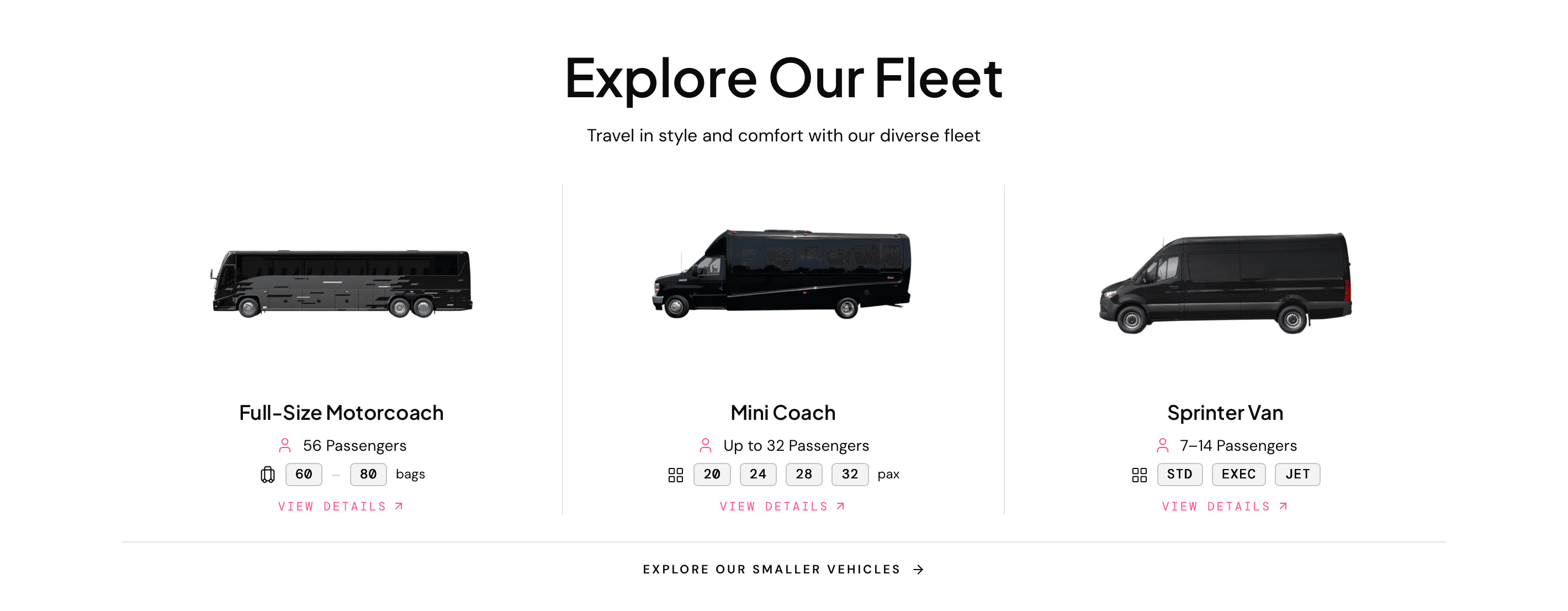
Up to 56 passengers · 60–80 bags
Up to 32 passengers
Up to 14 passengers
Total: 25 vehicles · Miami & Fort Lauderdale area
Service Categories
Miami Bus Company is a South Florida ground transportation company with more than 25 years of operating history and a fleet of 25 vehicles serving Miami, Fort Lauderdale, and the surrounding region. With over 200,000 rides completed, the company has built one of the more substantial operational track records in the South Florida group transportation market.
Their service range is broad: airport and group transfers, corporate and event shuttles, weddings and special occasions, city tours, hourly charter, and port transportation serving both PortMiami and Port Everglades. The fleet runs three distinct vehicle categories — full-size motorcoach, mini coach, and Sprinter van — covering group sizes from executive transfers to 56-passenger motorcoach moves.
The motorcoach, in particular, represented a commercial priority for the business. The owner understood that motorcoach bookings — corporate charters, large group transfers, port runs — were among the highest-value bookings in the fleet, and he wanted the motorcoach to be the centerpiece of the new website. Not buried in a fleet page. A centerpiece.
When Growth Choice began working with Miami Bus Company, what existed was an operation that had earned its standing over 25 years. What it lacked was a digital presence that reflected any of that — and, as we would discover, a visual library sufficient to build one.
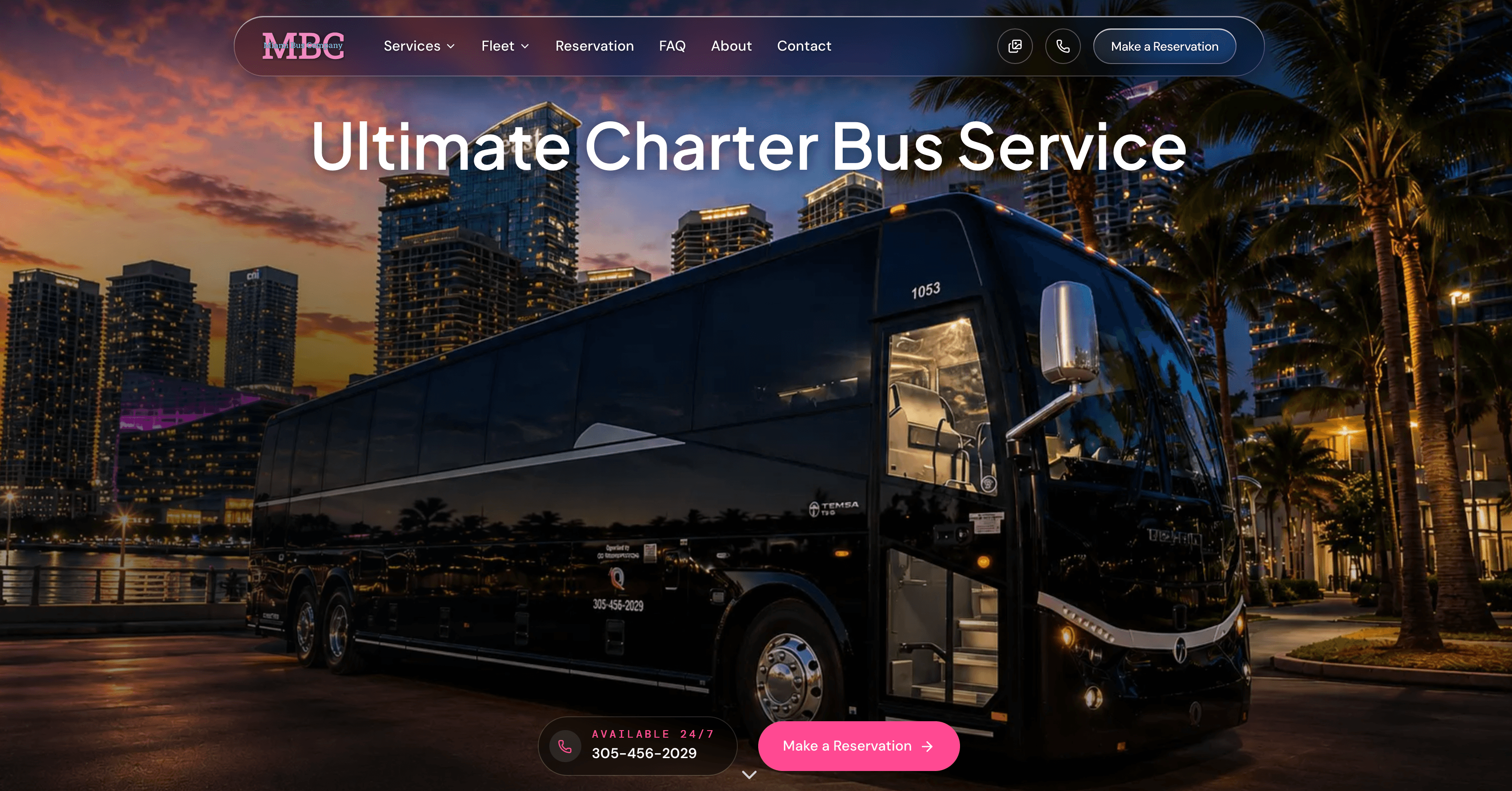
The website — homepage hero
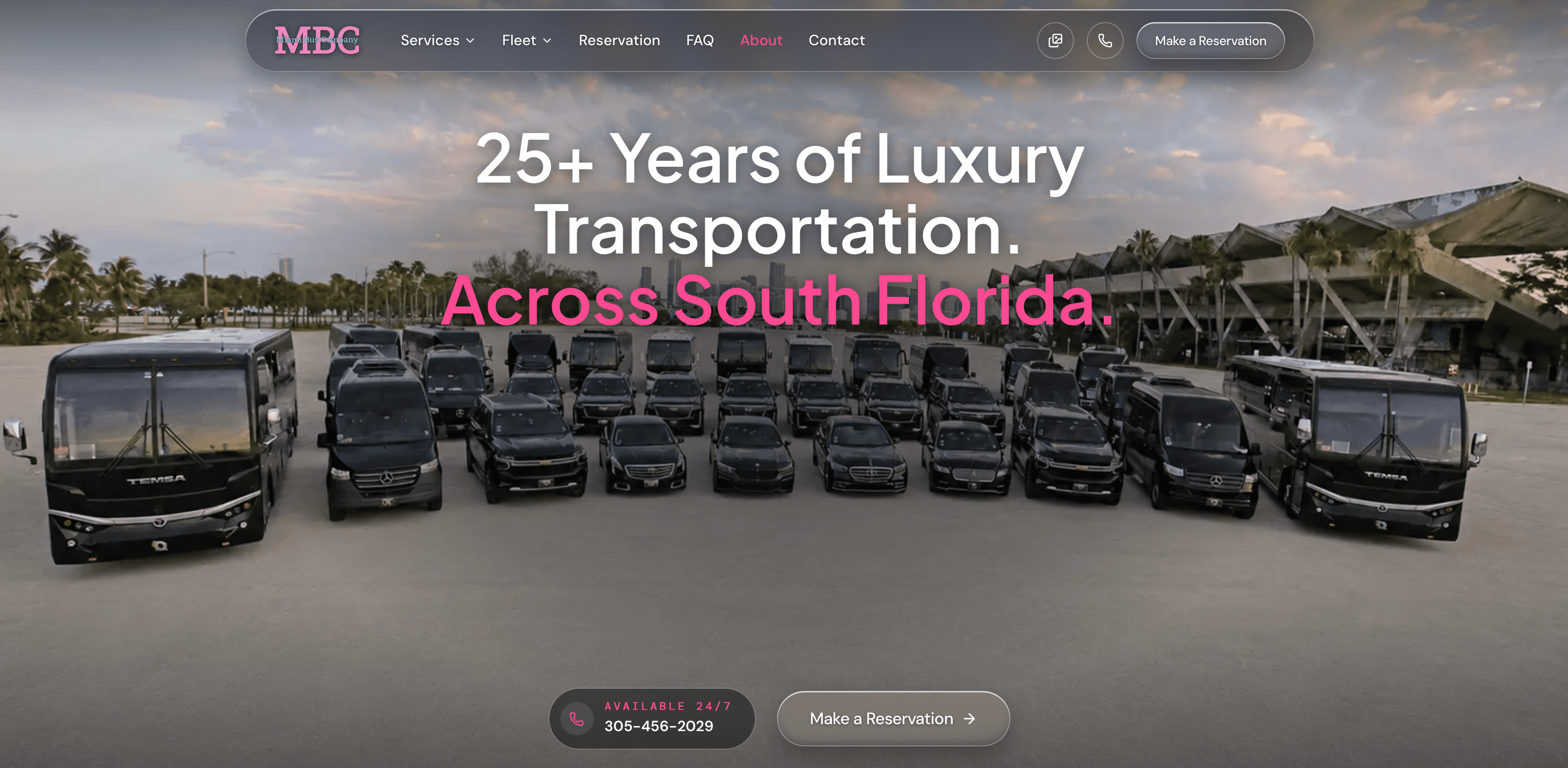
A 25-Vehicle Operation. Not Enough Images to Tell the Story.
Building a custom website for Miami Bus Company presented Growth Choice with several challenges simultaneously — and they were not all digital. The most immediate was the one most agencies would have handed back to the client: the company did not have a large library of high-quality photography to work with.
This created four distinct problems that had to be resolved before the website could be what it needed to be.
Visual Challenge
The existing image library was limited — both in quantity and quality. Building a premium custom website on an insufficient visual foundation would have undermined everything the design was trying to communicate.
Commercial Challenge
The owner wanted the motorcoach to be the centerpiece of the new website — a direct reflection of the business priority. But the motorcoach, in particular, did not have photography at the quality level the site required.
Authenticity Challenge
Generic stock charter-bus imagery was not acceptable. It would not represent Miami Bus Company's actual fleet, and prospective clients comparing operators would recognize the inauthenticity immediately.
Search Challenge
At the same time, the entire site had to be architected for SEO, AEO, high-intent keywords, search engine crawlability, LLM understanding, and long-term organic visibility — from day one of the build.
“The visual challenge was not the client's problem to solve before the project could start. It was our problem to solve as part of the project.”
Before
After
Five Layers of Custom Craftsmanship
Growth Choice structured the Miami Bus Company engagement around five connected layers. A completely custom website established the foundation. Search-led information architecture gave every service and vehicle its own discoverable home. Creative production solved the visual challenge — through restoration, AI-assisted imagery, and on-site photography. Technical SEO and AEO built the infrastructure for search engines and AI systems to understand the business accurately. Each layer required genuine judgment, not a templated solution.
Lever 1
Completely Custom Website — Built for Miami Bus Company Specifically
Miami Bus Company received a website built from scratch. Not a WordPress theme with updated colors. Not a bus-company template with the logo swapped in. Every section, every layout decision, every piece of information architecture was designed around the actual company: its 25-vehicle fleet, its South Florida operation, its motorcoach as the commercial centerpiece, and its six distinct service categories.
This distinction is worth explaining, because the industry default is different. Most transportation companies receive a website built on a premade template — an existing layout used across dozens of other bus and limo operators, with the company name inserted and the colors adjusted. The template optimizes the agency's production time. The custom build optimizes the client's business.
A company operating a 25-vehicle fleet for 25+ years should not look like a two-vehicle startup running an off-the-shelf template. The website needs to communicate scale, history, service breadth, and the kind of operational credibility that earns large corporate and group bookings. That is not achievable with a generic layout designed to work for any transportation company in any city.
Template Approach
Growth Choice Approach
How the fleet hierarchy maps to visitor intent
Group Size
7–14 · 20–32 · 56 passengers
Vehicle Type
Sprinter · Mini Coach · Motorcoach
Service Category
Airport · Wedding · Corporate · Port
Quote Request
Clear conversion path
The website architecture ensures visitors can navigate directly from their group size to the right vehicle to the right service — without having to interpret industry terminology.
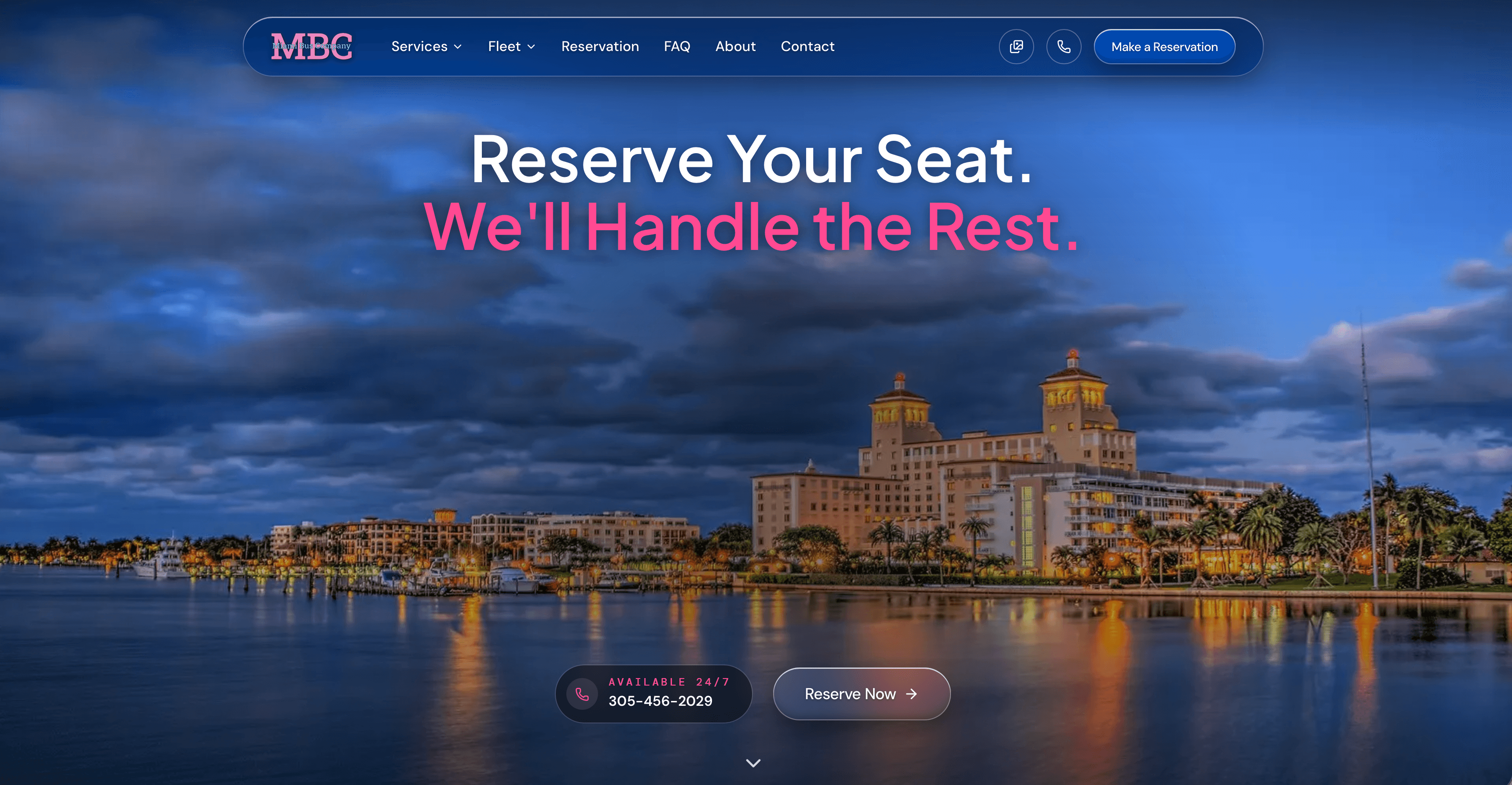
The website — reservation page
Lever 2
Search-Led Information Architecture — Every Page Has a Job
SEO is not something Growth Choice adds to a website after it is finished. It influences the build itself. Before a single page was laid out, Growth Choice conducted keyword and intent research across the South Florida charter bus and group transportation market — studying which services generated meaningful search demand, how prospective clients described their transportation needs, and what structure would give the site the strongest organic foundation.
The research shaped the information architecture directly. Instead of a single generic “Services” page combining everything into one undifferentiated list, the site was organized around actual user intent — with dedicated pages for each service category and dedicated fleet pages for each vehicle type.
Someone searching for “56 passenger charter bus Miami” has different intent than someone searching for “Sprinter van Miami airport transfer.” Both are prospective clients — but they need different information, different vehicle options, and different conversion paths. Sending both visitors to the same generic homepage wastes the opportunity each search represents.
Every page decision — the URL structure, the H1 and H2 hierarchy, the content depth, the FAQ content, the internal links — was treated as both a design decision and a discoverability decision. The two are not separate projects. They are the same project.
How search intent maps to dedicated pages
Each page was designed to be the most relevant result for its target intent — not a generic placeholder that happens to mention the right keywords.
“Every page decision is both a design decision and a discoverability decision. Treating them as separate projects is how you end up with a beautiful website that no one finds.”
The website — fleet page with vehicle architecture
Lever 3
Creating a Visual Library From Limited Assets
The project began with a limited image library. The available assets were inconsistent in quality — some usable, some requiring significant work, and some not suitable for a premium custom website at all. Rather than returning the problem to the client or filling the site with generic stock photography, Growth Choice approached it as a production challenge with multiple tools available.
The first step was working with the existing assets. Images were cleaned, retouched, upscaled where resolution permitted, and reframed where the composition needed correction. Some images could be salvaged into serviceable assets. Others could not — but they could serve a different purpose: as visual references.
This is where the approach became more involved. For service categories that lacked any usable photography — a wedding scene, an airport transfer, a port run, a corporate group boarding — Growth Choice used the company's actual fleet vehicles as references to create contextual imagery. Not generic bus imagery. Not stock photography with a different operator's vehicles. Images grounded in Miami Bus Company's real fleet.
The principle that governed this work: the goal was not to generate an AI image. The goal was to create the photograph we wished had been captured professionally in the first place.
“The goal wasn't to create an AI image.
The goal was to create the photograph we wished existed.”
Visual production workflow
01
Source Asset
Original fleet image — limited quality, inconsistent lighting, insufficient for premium use
02
Restoration
Clean, upscale, correct exposure, improve clarity, reframe where needed
03
Reference + Context
Real vehicle used as reference. Generate contextual scene preserving vehicle identity
04
Final Asset
Credible, brand-accurate image — wedding, airport, port, corporate — on the website
Throughout this process, one rule was non-negotiable: the vehicles had to remain recognizable as Miami Bus Company's actual fleet. The body configuration, the window layout, the proportions, the finish — these are the identifying characteristics that connect the image to the real company. Changing the background or adding people or adjusting the lighting is contextual work. Changing the vehicle itself would have produced imagery that was misleading rather than representative.
The result was a visual library with more range and more quality than the project started with — without using generic stock photography and without misrepresenting the actual fleet.
We Could Have Asked the Client. We Drove to the Garage Instead.
The visual production work covered most of the fleet. Restoration, AI-assisted contextual imagery, upscaling — together they created a working visual library for the Sprinters, the mini coaches, and many of the service scenarios. But one problem remained, and it was the most commercially important one.
The full-size motorcoach.
The motorcoach was supposed to become the visual centerpiece of the website. The owner was clear about this: motorcoach bookings were a priority, and he wanted the vehicle to command attention. But the available motorcoach photography was not at the quality level the site required. We had restoration and AI-assisted production as options — but AI-assisted imagery works best when the source references are good. The motorcoach references were not strong enough to produce the hero-quality output the site needed.
The obvious path would have been to contact the client and ask for additional photography. Coordinate someone at the garage. Schedule a shoot. Wait for the assets to come in. Adjust the project timeline accordingly.
Growth Choice considered that path and chose a different one. The owner operates and manages a 25-vehicle transportation company. He had trusted us with the project and the timeline. Adding photography coordination to his to-do list was avoidable. So we made it avoidable.
Growth Choice drove to Miami Bus Company's garage and photographed the motorcoach directly.
“We could have emailed the client and asked for better photos. Instead, we drove to the garage.”
This is not a story about going above and beyond. It is a story about how Growth Choice defines the scope of a project. The scope is not the list of deliverables in the contract. The scope is the result we committed to delivering. When a problem stands between the current state and that result, the question is not “whose problem is it?” — the question is “what is the most practical way to solve it?”
In this case, the most practical solution was also the most direct one. We needed photographs of the motorcoach. We were capable of taking them. We did.
The on-site photography produced clean, high-quality images of the actual vehicle — the real Miami Bus Company motorcoach, photographed specifically for this website. Those images became the foundation for the hero visuals, the fleet detail page, and the AI-assisted contextual imagery for service-specific scenarios. The motorcoach now occupies its intended place on the website: the centerpiece.
The motorcoach — now the visual centerpiece
The Underlying Principle
Growth Choice approaches every project as if it were building for itself. That means taking ownership of problems even when those problems were not in the original brief — because a result that falls short of what was committed is not acceptable regardless of whose fault the shortfall technically is. The garage visit was not unusual. It was what the project required, and so it was what happened.
Lever 5
Technical SEO + AEO — What Search Engines and AI Systems Read
The surface of the Miami Bus Company website is what visitors experience. Underneath it sits a technical infrastructure that determines how search engines and AI systems understand the business — and most of that infrastructure is invisible to human visitors.
Growth Choice built this layer with the same intentionality as the design itself. The elements covered include the fundamental infrastructure that every transportation website needs to compete in both traditional and AI-powered search.
What Visitors See
What Machines Read
Built for AI Search — Conversational Queries and Intent
A growing portion of transportation research happens through AI assistants. Prospective clients ask ChatGPT which bus company in Miami can transport 50 people. They ask Perplexity about port transportation in South Florida. They ask Gemini what the difference is between a motorcoach and a mini coach. These are real research queries from real prospective clients — and the websites that answer these questions most clearly are the ones best positioned to be referenced in those conversations.
AEO (Answer Engine Optimization) does not guarantee citations. No implementation does. What it creates is the conditions under which AI systems are best equipped to understand who Miami Bus Company is, what vehicles they operate, what services they provide, and what geographic area they serve. The FAQ architecture, the structured vehicle descriptions, the service-specific content, and the schema markup all contribute to this.
FAQ Architecture
Structured Q&A on vehicle capacities, luggage, service areas, and booking — answering the questions AI systems encounter from real prospective clients
Entity Clarity
Consistent company name, address, phone, vehicle types, and service descriptions across all pages — creating strong entity recognition for AI systems
Structured Data
Schema markup explicitly declaring what Miami Bus Company is, what vehicles operate, what services are offered, and where — in machine-readable format
Semantic Structure
Heading hierarchy and page relationships that signal topical authority across fleet types, service categories, and South Florida geography
Turning operational knowledge into structured web content
Transportation companies contain enormous amounts of useful knowledge that prospective clients need to make decisions. Vehicle capacities. Luggage allowances. Service areas. What size bus fits a 30-person corporate group. Whether the motorcoach can handle airport runs. Whether Miami Bus Company serves the Keys. This knowledge exists inside the company — in the heads of dispatchers, operators, and the owner.
The Miami Bus Company website converts that knowledge into structured, crawlable web content. FAQ sections answer the questions prospective clients ask before they call. Service pages explain what happens on each type of trip. Fleet pages provide the specific capacity and configuration details that group organizers need to make a vehicle decision. The information works continuously — for human visitors and for the AI systems that increasingly mediate how people research transportation options.
Examples of prospective-client questions the FAQ architecture directly addresses
A Digital Platform That Matches the Operation
100%
Custom Website
Zero premade templates used
25
Fleet Vehicles
Represented in structured digital experience
25+
Years Represented
Operational credibility finally matched digitally
Full
Technical SEO Stack
Sitemap · Schema · Metadata · llms.txt
AEO
AI Search Architecture
Built for Google, ChatGPT, Gemini & Perplexity
On-Site
Fleet Photography
Growth Choice photographed the motorcoach directly
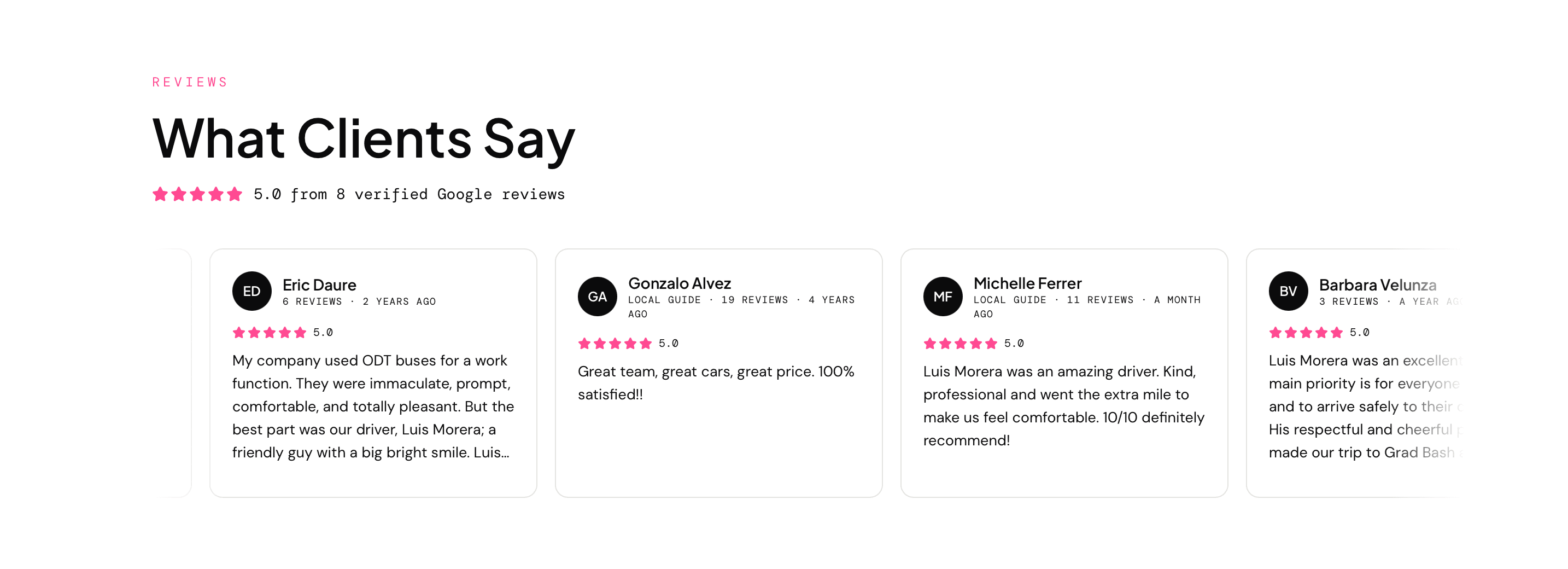
The website — client reviews section
Miami Bus Company now has a custom digital platform that represents the actual scale of the operation. The motorcoach — the commercial priority from the beginning — is the visual centerpiece of the website, presented with real photography, accurate specifications, and clear use-case context. The entire fleet is represented in a structured experience that helps visitors navigate from group size to vehicle to service to quote without confusion.
The search architecture gives each service category and vehicle type its own page, its own keyword focus, and its own conversion path. The technical foundation gives search engines and AI systems everything they need to accurately understand the business, its services, its vehicles, and its South Florida service area.
This is not simply a website. It is the digital representation of an operation that has been running for 25+ years and completing group transportation bookings at scale across South Florida. The website now reflects that reality — and creates the conditions for prospective clients searching for group transportation in Miami to find it, understand it, and convert.
What This Project Demonstrates
A website should reflect the actual scale of the operation.
Miami Bus Company had 25+ years of operational history and a 25-vehicle fleet. A generic template website signals a different reality than that. The digital representation of a company either confirms or contradicts what prospective clients sense about the business. Custom development is the only reliable way to close that gap.
Limited photography is a solvable problem — if you approach it strategically.
Most agencies treat limited assets as the client's problem to resolve before the project can move forward. Growth Choice treated it as a design and production challenge. The combination of image restoration, AI-assisted contextual production using real vehicles as references, and on-site photography created a more complete visual library than the project started with.
AI imagery works best when grounded in real fleet assets.
The most credible AI-assisted images are the ones that preserve the identity of the actual vehicle. Generic bus imagery generated without fleet-specific references may be technically impressive but is ultimately misleading — it represents a vehicle that does not exist in the actual fleet. Fleet-accurate contextual imagery communicates the company's real product in a believable environment.
Sometimes the right solution is operational, not digital.
When the motorcoach photography was not good enough for the centerpiece of the site, the problem was not a software problem or a prompt engineering problem. It was a photography problem. The right solution was to go take photographs. Growth Choice drove to the garage and did that — rather than building a workaround on top of an insufficient foundation.
SEO should be integrated into the build, not added after it.
Every page decision — naming, heading structure, URL, content depth, internal links — affects how search engines and AI systems understand the site. When these decisions are made during development, they reflect the site's actual information hierarchy. When they are applied afterward as a checklist, they often conflict with the structure that was built without them in mind.
Operational expertise should be converted into structured web content.
Transportation companies contain enormous amounts of useful knowledge that prospective clients need: vehicle capacities, luggage allowances, service areas, vehicle types for different group sizes, booking policies, occasion-specific guidance. When this knowledge exists only in the heads of dispatchers and operators, it cannot help a prospective client at 10 PM on a Sunday. On the website, it works continuously.
Build Your Platform
Your fleet has a story.
Your website should tell it.
Growth Choice builds completely custom digital platforms for transportation companies — designed around the actual fleet, the actual services, and the actual acquisition goals. No templates. No generic layouts. No borrowed designs.
Questions About Charter Bus Websites, SEO & AEO
Templates are designed to optimize the agency's production workflow — they allow fast delivery by reusing the same layout across many clients. A custom website is designed to optimize the client's actual business. For a charter bus company, this means the site is built around the specific fleet, the specific services, the specific market, and the specific buyer types the company serves. The result is a website that communicates the company's actual scale and capability — not a generic transportation template that could belong to any operator in any city.